

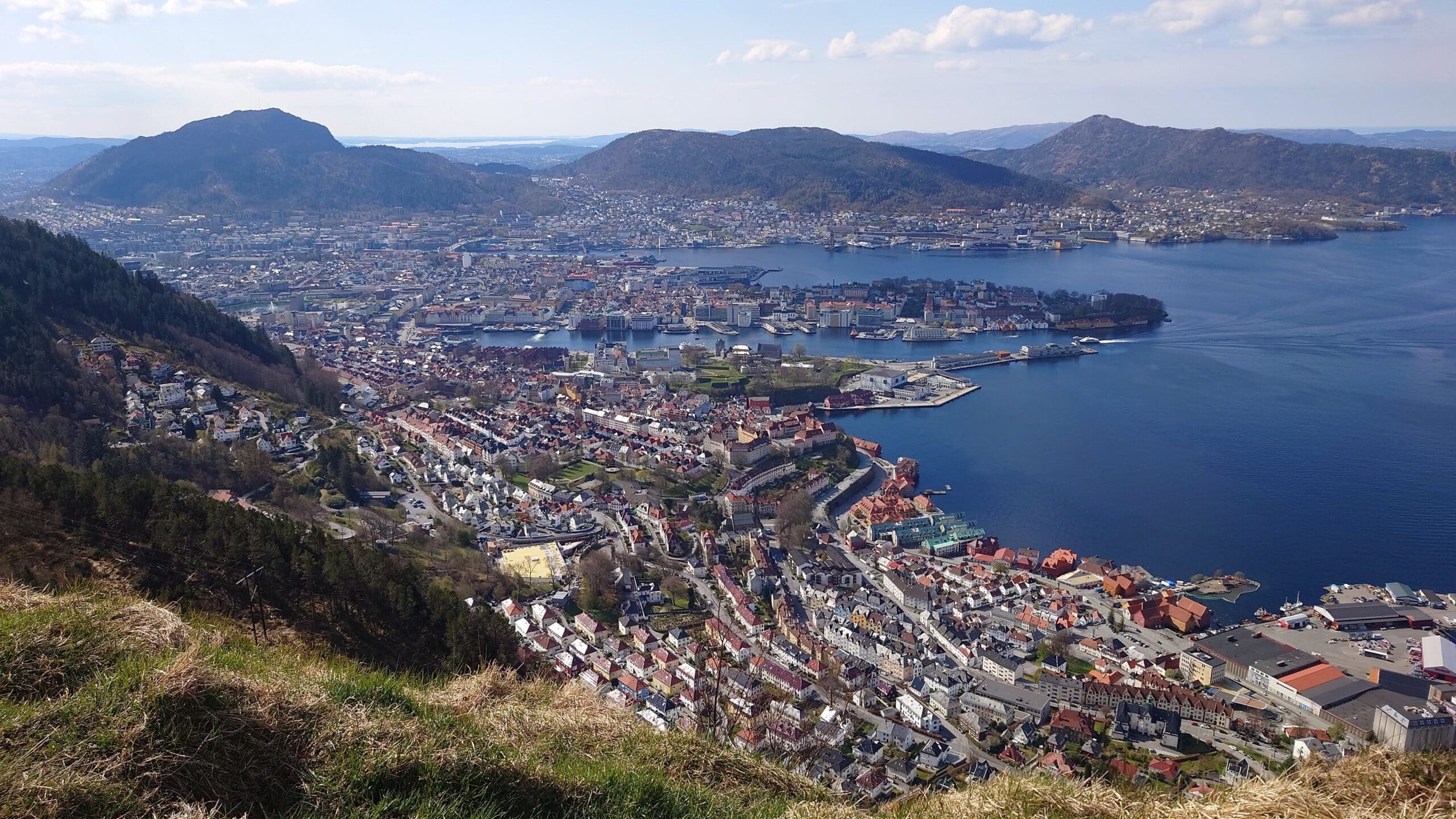
The Best Hiking Spots in Bergen for Beginners
Explore the best bergen hiking spots with trails for every skill level and stunning mountain views around Bergen.
When wandering the streets and shoreline of Bergen, it’s easy to feel the presence of old stories lingering in the landscape. Norway’s west coast is steeped in legends, and the dramatic mountains and fjords surrounding Bergen seem woven from the same fabric as the ancient Norse myths.
For guests who join our walking tours, understanding these stories adds another layer of meaning to the places we explore. One of the most remarkable tales is the Norse story of how life itself began. Below, you’ll find a retelling designed to bring the mythology to life—perfect reading before or after a stroll through our city’s historic heart.
Norse mythology does not begin with a distinct moment of creation, but rather draws us into an era before time existed—a boundless void where the notion of a beginning had not yet taken shape. In this primordial state, the universe lacked stars, the sky had not yet assumed its blue hue, and the earth did not exist to provide grounding. Existence itself was defined by two contrasting realms, each suspended within endless emptiness: Niflheim and Muspell.
To the north lay Niflheim, a realm shrouded in impenetrable mists and pervaded by an unrelenting, bitter cold. This environment was bleak and inhospitable, its harshness concealing all within. At the heart of Niflheim was Hvergelmyr, a mysterious and ancient well. From this well, eleven rivers flowed forth, each stream carrying waters tainted with poison. The forbidding nature of Niflheim set the foundational atmosphere for the dramatic events that would eventually forge the cosmos.
In stark contrast to Niflheim, Muspell extended across the south as a blazing land of fire and heat. Muspell was not composed of solid ground; instead, it was a turbulent expanse of molten rock, flowing lava, and ceaseless flames. The intense energy and searing light of Muspell stood in direct opposition to the darkness and cold that defined Niflheim. The interplay between these two realms became central to the mythic universe of the Norse.
Where the raging flames of Muspell met the icy mists of Niflheim stood Surtr, a formidable guardian present before even the gods themselves. Surtr watched over this boundary, wielding a powerful, flaming sword. His vigil would last until Ragnarok, the foretold end of the world, when he would finally leave his post to unleash fire upon the world and destroy the gods one by one with his blazing weapon.
Between Niflheim and Muspell there existed a vast void known as Ginnungagap. This space was devoid of substance or form. The rivers that originated in Niflheim flowed into Ginnungagap, where, over millennia, they transformed into immense glaciers. At the point where the ice of Niflheim met the fire of Muspell, the ice melted, giving rise to water. It was in this unique confluence that the first life emerged.
From the mingling of melting ice and fire sprang Ymir, a giant whose size surpassed both worlds and who was neither male nor female. Ymir was the forebear of all giants. However, Ymir was not the only life to arise from the melting waters. Alongside the giant appeared a colossal cow, who survived by licking the ice for sustenance. This cow, named Audhulma, produced rivers of milk, which nourished Ymir and sustained him in this early world.
In the beginning, Audhumla, the primeval cow, sought sustenance by licking the salty ice. Remarkably, as she continued, strands of hair belonging to a man gradually emerged from the ice. On the second day, the man’s head became visible, and by the third day, his entire body had appeared. This man was named Buri and he became the forefather of all the gods.
Meanwhile, as Ymir, the giant, slept, other beings came into existence. From beneath Ymir’s arm, a male and a female giant were born. Additionally, from its legs emerged a six-headed giant.
Buri took one of the giants as his wife, and together they had a son named Bor. Bor then married Bestla, who was the daughter of another giant. Their union produced three sons: Odin, Ve, and Vil.
As Odin, Ve, and Vil grew up, they gazed into the distance and saw the flames of Muspell as well as the darkness and mists of Niflheim. They found themselves trapped in Ginnungagap, a vast emptiness where neither earth nor sky existed, only a void waiting to be filled with life.
The three brothers discussed the situation and realised there was only one solution. To create the world, Ymir, the giant, had to die. They stabbed the giant to death, and its blood poured out with such force that it swept away and drowned all the other giants, except for Bergelmyr and his wife. All giants who exist today are said to be descended from this couple.
Odin and his brothers used the flesh from Ymir to make the soil, his bones were piled into mountains. The rocks, pebbles and sand we see were fragments of his bones and teeth ground down by the brothers. The seas were his sweat and blood and the sky, the inside of its skull whilst the clouds are Ymir’s brains.
The world, as everyone knows, is shaped like a simple disc and is encircled by vast seas. At the very edge of this world resided the giants, formidable beings who posed a constant threat. To protect themselves and the world from these giants, Odin and his brothers constructed a mighty fence using the eyelashes of Ymir. This safeguarded area became known as Midgard.
Despite the protection offered by the fence, Midgard remained empty. Odin and his brothers searched tirelessly for days, yet no living soul could be found. Their search eventually led them to two logs washed ashore on the rocky coast—one made of ash and the other of elm. The ash wood, known for its carvability and resilience against splitting, was ideal for crafting spears, while the elm, being exceptionally hard, was perfect for building robust structures.
The gods set these logs upright in the sand, placing them side by side. Odin breathed life into them, and Ve skilfully carved them into human forms—one male and one female. Vili bestowed intelligence upon them. To ensure their comfort, the brothers fashioned clothes for them, naming the male Ask and the female Embla.
Ask and Embla lived safely behind the protective wall made from Ymir’s eyelashes. This allowed them to raise their children, free from the danger posed by giants and other threats lurking beyond Midgard. All people on earth trace their ancestry back to Ask and Embla.
Odin became known as the all-father. He is regarded as both the father of the gods and, having breathed life into Ask and Embla, the father of all mortal beings. Thus, whether one is a god or a mere mortal, Odin is recognised as the father of all.
If Norse mythology captures your imagination, you’ll love exploring Bergen with guides who share these stories where they’re most alive—right here among the fjords and mountains.
Book a tour with I Love Bergen and walk through a city where history and legend meet around every corner.
Whenever you’re ready for the next myth, story, or hidden Bergen gem—just let me know!
Want more local tips? Be sure to join us on a walking tour of Bergen! Click the button below to view our tours.
Explore the best bergen hiking spots with trails for every skill level and stunning mountain views around Bergen.
We are proud to be launching new tours in 2025!

Ut enim ad minim veniam, quis nostrud exercitation ullamco laboris nisi ut aliquip ex ea commodo consequat. Duis aute irure dolor in reprehenderit in